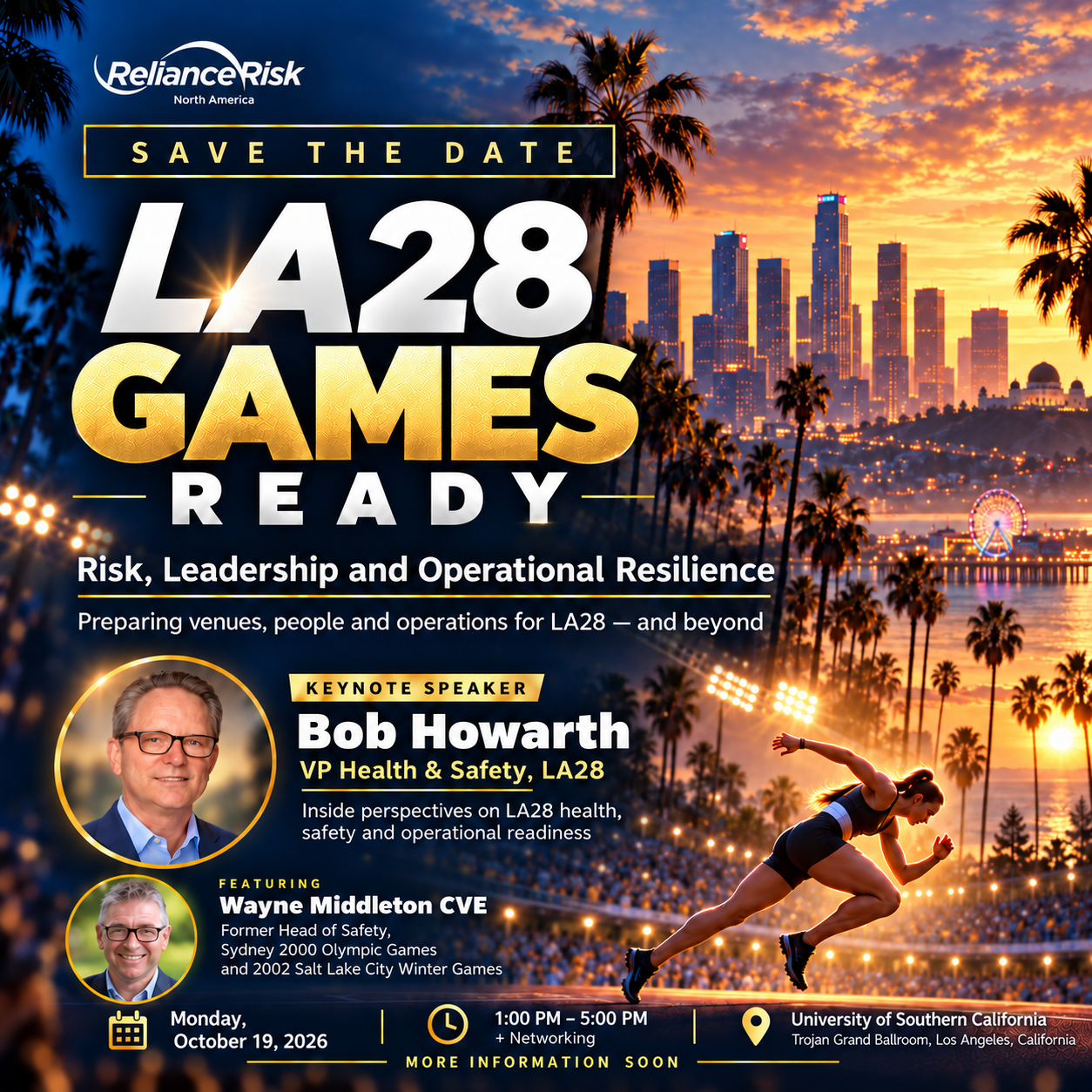
Risk, Leadership, and Operational Resilience. Preparing venues, people, and operations for the 2028 Games and beyond.
Presented by Reliance Risk North America, a Joffe company.
The LA28 Olympic and Paralympic Games represent much more than a major event on the horizon. They provide a unique opportunity for Southern California's venues, operators and public agencies to strengthen the capabilities that will support safe and successful Games delivery, and remain as an enduring legacy long after 2028.
Games Ready: Risk, Leadership and Operational Resilience brings together senior Games, venue, safety, emergency management and resilience practitioners to explore what being “Games Ready” really means.
The seminar will examine lessons from previous Olympic and Paralympic Games, the emerging LA28 operating environment, emergency and business continuity preparedness, medical planning, operational readiness and the role of existing venue teams in delivering one of the world's largest events.
The focus is practical: what can venues start doing now, what can be tested before 2028, and how can Games preparation leave venues and communities better equipped for the future?
A brief introduction to Reliance Risk North America, the purpose of the Games Ready seminar and the opportunity presented by LA28 to build stronger venue capability across Southern California.
The opening will establish the central theme for the afternoon: Games preparation should not simply be about being ready for several weeks in 2028, it should create safer venues, stronger teams and more resilient organizations for years to come.
LA28 presents a Games delivery model unlike many previous Olympics and Paralympics. Its emphasis on using existing venues places established venue operators, workforces and operating systems at the heart of Games delivery.
In this keynote presentation, Bob Howarth will provide an inside perspective on the evolving health, safety and operational environment for LA28 and what it means for venues preparing to participate in the Games.
The “Radical Reuse” Foundation: How LA28's reliance on existing venues changes the relationship between the Organising Committee and venue operators, and why existing venue teams will play such an important role in Games delivery.
The Emerging Health & Safety Operating Model: How Health & Safety interfaces across Event Management, Logistics, Medical, Security, Venues & Infrastructure and Transport, and how those functions come together operationally at venue level.
The Road to 2028: The major planning and operational challenges that will need to be addressed over the coming years, including:
Where Venues Can Engage Now: Practical opportunities for collaboration between LA28 and venue operators, including:
Participants will gain a clearer understanding of:
Includes audience Q&A.
Twenty-eight years after Sydney 2000, what can the actual experience of injuries, incidents and operational risk during an Olympic Games tell today's venue operators?
Drawing on the Sydney 2000 Olympic Personal Injuries Study and his direct experience leading Games safety, Wayne Middleton will examine what actually caused people to be injured during Games operations, and how those lessons remain relevant to LA28.
The session moves beyond theoretical risk registers to examine the realities of operating complex venues and temporary event environments involving spectators, workforce, contractors, athletes, officials and large-scale public movement.
The session will consider how historical incident data can help LA28 venues ask better questions now:
And how can Games planning improve everyday venue safety after 2028?
Participants will leave with practical lessons for:
Includes audience Q&A.
LA28 will require venues to examine their operations at a level of detail rarely demanded by business-as-usual events. That creates an opportunity that extends well beyond sport.
Southern California has repeatedly experienced wildfire, earthquake, extreme weather, infrastructure disruption and other emergencies. Major venues can themselves become critical community assets during disruption, while also needing to protect their own people, systems and ability to continue operating.
This session explores how the journey to LA28 can become a practical resilience initiative for participating venues.
Understanding Vulnerability: Using Games planning to examine dependencies on power, communications, transport, water, technology, suppliers, people and critical infrastructure.
Emergency Planning Under Games Conditions: Testing whether existing emergency systems, command structures and venue teams will continue to perform when the scale, complexity and operating environment change.
Business Continuity and Disruption: Understanding what happens when critical services are unavailable, access is restricted, technology fails, suppliers cannot deliver or normal venue operations are interrupted.
Venues as Community Assets: Considering the wider role major venues may play during disasters, including their potential use for coordination, shelter, logistics, staging or community support.
Exercises That Build Organisational Memory: Using tabletop exercises, simulations, rehearsals and Games test events to build familiarity, confidence and decision-making capability within the teams who will ultimately need to respond.
Operational Readiness and Contingency Planning: Moving from written plans to demonstrated capability: knowing what can go wrong, who makes decisions, what alternatives exist and whether the organisation can continue to operate.
Participants will consider how LA28 preparation can help them:
Includes audience Q&A.
The final session brings the afternoon together in an interactive discussion about what a genuinely Games-ready venue should look like by 2028.
Rather than another formal presentation, the session will explore the practical issues facing venue operators and provide an opportunity for audience questions and discussion with the seminar speakers.
Medical and Paramedic Readiness
People and Workforce
Command, Control and Coordination
Testing Readiness
Perhaps most importantly:
What should be different about a Southern California venue on the day after the Paralympic Closing Ceremony because it participated in LA28?
The discussion will consider how investment in medical capability, emergency planning, workforce development, safety systems, business continuity and interagency relationships can become an enduring Games legacy rather than temporary Games infrastructure.
A short facilitated wrap-up identifying the major themes from the afternoon and the practical actions venue operators can begin taking on the road to LA28.
The seminar concludes with a simple challenge: use 2028 as the deadline, but build capability for the future.
Continue the conversation with speakers, venue operators and colleagues from across the Southern California sports, entertainment, emergency management and major-event community.